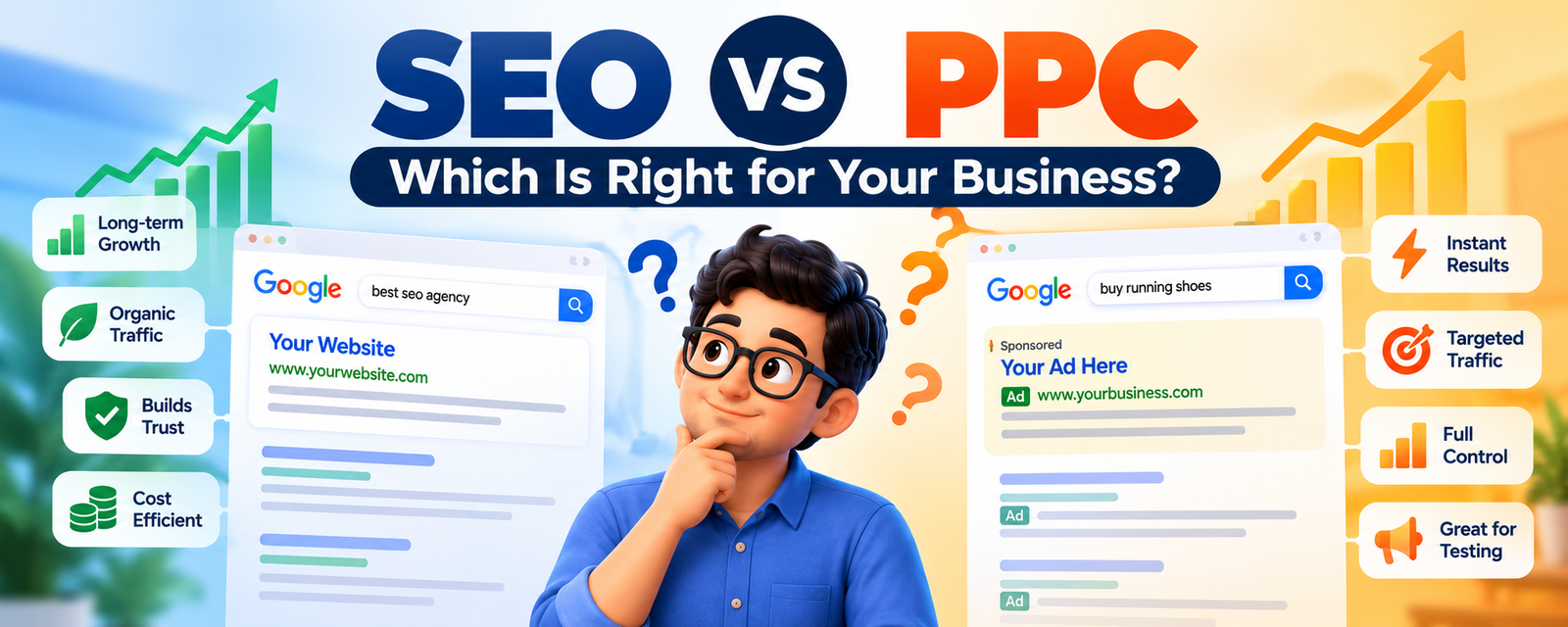
Key takeaways
- SEO earns free, compounding clicks from organic results but takes months. PPC buys clicks instantly but stops the moment you stop paying.
- The right choice depends on three things: how urgently you need leads, how much a customer is worth to you, and how competitive your keywords are.
- For most businesses, the answer isn't either/or. Use PPC for speed and testing, SEO for long-term cost efficiency, and let each channel's data improve the other.
"Should we do SEO or Google Ads?" is one of the first questions founders ask us. It's a fair question. Budgets are limited, and both channels claim to bring customers from search. But the question itself hides an assumption: that these are two versions of the same thing. They're not. They behave differently, cost differently, and fail differently.
Let's break down what each one is, where each shines, and how to decide what's right for your business.
What's the difference between SEO and PPC?
SEO (search engine optimisation) is the work of improving your website so it appears in the unpaid, organic results. You don't pay Google per click. You invest in content, technical improvements, and reputation, and you earn positions over time. If you're new to it, our complete guide to SEO covers the basics.
PPC (pay-per-click) means paying for ads that appear above or below organic results, marked "Sponsored". On Google, this is Google Ads. You bid on keywords and pay each time someone clicks.
You'll also hear SEM (search engine marketing). Strictly, SEM covers all marketing on search engines, paid and organic. In practice, many people in India use "SEM" to mean paid search only. When someone says "SEO vs SEM", they usually mean organic vs paid.
SEO vs PPC at a glance
| Factor | SEO | PPC (Google Ads) |
|---|---|---|
| Cost model | Fixed investment in people, content, and tools; no cost per click | Pay for every click; cost rises with competition |
| Time to results | Usually 3 to 6 months for early traction, longer in competitive markets | Traffic can start the same day campaigns go live |
| When you stop | Rankings decline slowly; traffic doesn't vanish overnight | Traffic stops immediately |
| Control | Indirect; you influence rankings but can't buy them | Direct control over keywords, copy, budget, schedule, and location |
| Click-through trust | Many users prefer organic results | Clearly labelled as ads; some users skip them |
| Scalability | Grows with content and authority; cost per lead falls over time | Grows with budget; cost per lead often rises as you scale |
| Testing speed | Slow to test messages or offers | Very fast; A/B test headlines and landing pages within days |
| Visibility in AI answers | Strong SEO helps you get cited in AI Overviews and AI assistants | Ads don't make you a cited source |
When SEO is the better choice
You're building for the long term
SEO is an asset. A guide that ranks well keeps bringing visitors for months or years after it's written. Compare that to ads, where every visitor is rented.
Your customers research before buying
If your buyers search questions like "how much does ERP implementation cost" or "best dental implant options", they're in research mode. Ads can catch them, but helpful content that ranks earns trust across several visits. B2B services, healthcare, education, and high-value consumer purchases all fit this pattern.
Clicks in your industry are expensive
In categories like insurance, loans, legal services, software, and education, cost per click can be high. When every click costs a lot, the economics of ranking organically become very attractive.
You want to be the brand AI assistants mention
When someone asks ChatGPT or Google's AI Mode, "which SEO agency in Noida should I consider?", ads don't help. What helps is being a well-known, well-cited source across the web. That's an SEO and reputation job.
When PPC is the better choice
You need leads now
A new clinic opening next month, a seasonal sale, a product launch: PPC delivers visibility immediately. SEO can't.
You're testing a new offer or market
Before investing months in content for a new service, run a small ad campaign. In two to four weeks, you'll learn which keywords convert, what people respond to, and what a lead costs. That data is gold for your SEO plan later.
Your site is new, and your market is competitive
A brand-new website competing with established players might take a long time to rank for high-intent terms. PPC can bring business in while SEO builds.
You're promoting something time-limited
Diwali offers, event registrations, or admissions deadlines are short windows. By the time an organic page ranks, the window may be over.
Three real-world scenarios
Here's how the decision plays out for different kinds of businesses. The numbers are illustrative, so use your own data to decide.
Scenario 1: A dental clinic in Noida
Local, high-intent searches like "dentist near me" and "root canal treatment in Noida". The map pack dominates these results.
Best approach: invest first in local SEO and the Google Business Profile, since that's where most clicks go. Run a small PPC campaign for high-value treatments like implants while reviews and rankings grow.
Scenario 2: A B2B SaaS company in Pune
Buyers research for weeks, compare vendors, and read guides. Clicks for software keywords are costly.
Best approach: SEO-led. Build content around problems buyers search for, comparison pages, and integration guides. Use PPC narrowly: branded terms (to protect your name) and a few bottom-of-funnel keywords like "[category] software pricing".
Scenario 3: A D2C brand launching a new product
Nobody is searching for the product name yet, and the launch has a date.
Best approach: PPC and shopping ads for launch momentum, combined with SEO for category terms ("organic face serum for oily skin") that will bring traffic long after the launch buzz fades.
How to decide: five questions to ask
- How soon do you need results? Weeks → PPC. Months or longer → SEO carries more weight.
- What's a customer worth? Work out your lifetime value. If a customer is worth ₹2,00,000 and a lead costs ₹1,500 on ads with a 10% close rate, PPC is profitable. If margins are thin, SEO's lower long-term cost matters more.
- How expensive are clicks? Check estimated cost per click in Google Keyword Planner for your top 10 keywords.
- How strong is your website today? A site with solid content and some authority can see SEO results faster. A new site will take longer.
- Do you have capacity to create content? SEO needs consistent effort. If nobody can own that, PPC might be the only realistic channel for now.
The real answer for most businesses: use both, strategically
The best-performing businesses we've worked with don't treat SEO and PPC as rivals. They use each for what it does best:
- PPC finds the winning keywords. Ad data shows which search terms actually convert. Feed those into your keyword research and prioritise them for content.
- SEO lowers your blended cost. As organic rankings grow for a keyword, you can reduce ad spend on it and redirect budget elsewhere.
- Owning both spots builds trust. Appearing in the ad and the organic result for the same search increases the chance of a click and signals you're an established player.
- Remarketing connects them. Visitors who arrive through organic content can be retargeted with ads later in their decision.
A practical split for a business starting from scratch might be: heavier PPC in months 1 to 6 while SEO foundations are built, then gradually shifting budget toward SEO as organic leads grow. Track cost per lead from each channel monthly.
Common mistakes when comparing SEO and PPC
- Judging SEO after 60 days. That's like judging a mango tree after two months. Give it a fair timeline.
- Comparing clicks, not leads. What matters is cost per qualified lead and revenue, not traffic.
- Running ads to a weak landing page. The same slow, unclear page hurts both channels. Fix the page first.
- Bidding on everything. Broad match on vague keywords burns budget fast. Start narrow and high-intent.
- Treating SEO as a one-time project. Rankings need maintenance, just like ad campaigns need optimisation.
Frequently asked questions
1. Is SEO better than PPC?
Neither is better in every case. SEO is better for long-term, lower-cost traffic; PPC is better for immediate results and testing. Most businesses benefit from both.
2. What is the main difference between SEO and PPC?
SEO earns unpaid organic rankings over time. PPC pays for ad placements and charges per click, with results that start and stop with your budget.
3. Is SEO cheaper than Google Ads?
Over the long term, usually yes, because you don't pay per click. In the first few months, SEO can feel more expensive because you're investing before seeing results.
4. How long does SEO take compared to PPC?
PPC can drive traffic on day one. SEO typically shows early movement in 3 to 6 months and stronger results after 6 to 12 months.
5. Does running Google Ads help my SEO rankings?
No. Paying for ads doesn't improve organic rankings. However, ad data can guide your SEO keyword choices.
6. What is SEM?
SEM stands for search engine marketing. It technically includes both paid and organic search, but many people use it to mean paid search ads.
7. Should a new business start with SEO or PPC?
Usually both: PPC for early leads and learning, SEO foundations from day one so organic traffic grows while ad spend eventually comes down.
8. Which has better ROI, SEO or PPC?
SEO often delivers higher ROI over 12 months or more because costs don't scale with traffic. PPC delivers faster, more predictable ROI in the short term.
9. Can I stop SEO once I rank?
You can, but rankings usually slip as competitors keep improving. Ongoing updates and new content protect your positions.
10. Do people click organic results more than ads?
For many searches, organic results receive more clicks overall, though ads can perform very well for high-intent commercial queries.
11. What budget do I need for PPC?
Enough to get meaningful data, typically a few hundred clicks a month for your core keywords. Estimate using Keyword Planner's cost-per-click ranges.
12. What budget do I need for SEO?
It depends on your site, competition, and goals. A local business needs far less than a national e-commerce site. Be wary of packages that promise rankings at very low fixed prices.
13. Is PPC only Google Ads?
No. PPC also includes Microsoft (Bing) Ads, and pay-per-click models on social platforms like LinkedIn and Meta, though "PPC vs SEO" usually refers to search ads.
14. Can SEO and PPC target the same keywords?
Yes, and it often makes sense for your most valuable keywords. Owning both the ad and the organic spot increases your share of clicks.
15. Which works better for local businesses?
Local SEO, especially a strong Google Business Profile and reviews, is usually the best long-term investment. PPC helps fill gaps and promote specific services.
16. Which works better for B2B companies?
B2B buyers research heavily, so SEO content tends to work very well. PPC is useful for high-intent terms and protecting branded searches.
17. Does PPC help with AI search visibility?
Not directly. Being cited in AI Overviews or tools like ChatGPT depends on having trusted, well-structured content and a strong reputation, which is SEO territory.
18. How do I measure SEO vs PPC performance fairly?
Compare cost per qualified lead and revenue per channel over the same period, using GA4 and your CRM, not just clicks or traffic.
19. What happens to organic traffic if I pause SEO work?
It usually declines gradually over months rather than stopping. How fast depends on how competitive your market is.
20. Should I do SEO if my competitors dominate Google Ads?
Yes. Heavy ad competition usually means expensive clicks, which makes ranking organically even more valuable.
The bottom line
PPC is a tap: turn it on, traffic flows; turn it off, it stops. SEO is a well: slow to dig, but it keeps giving. Smart businesses use the tap while they dig the well.
Written by Ashwini
Technical author & editor at W3XHTML publishing guides on web development and SEO.