Key takeaways
Early in my career, I watched a client spend three months polishing a service page for the keyword "how to reduce electricity bill at home". It was beautifully designed, fast, and full of the right words. It never got past page four.
The reason was simple. Everyone searching that phrase wanted practical tips: switch off the geyser, check the AC temperature, replace old bulbs. Google knew that, so it ranked list-style guides and videos. A page selling solar installation, however good, was answering a question nobody asked.
That's search intent in one story. Before you think about keywords, word count, or backlinks, you need to know what the searcher actually wants.
What is search intent?
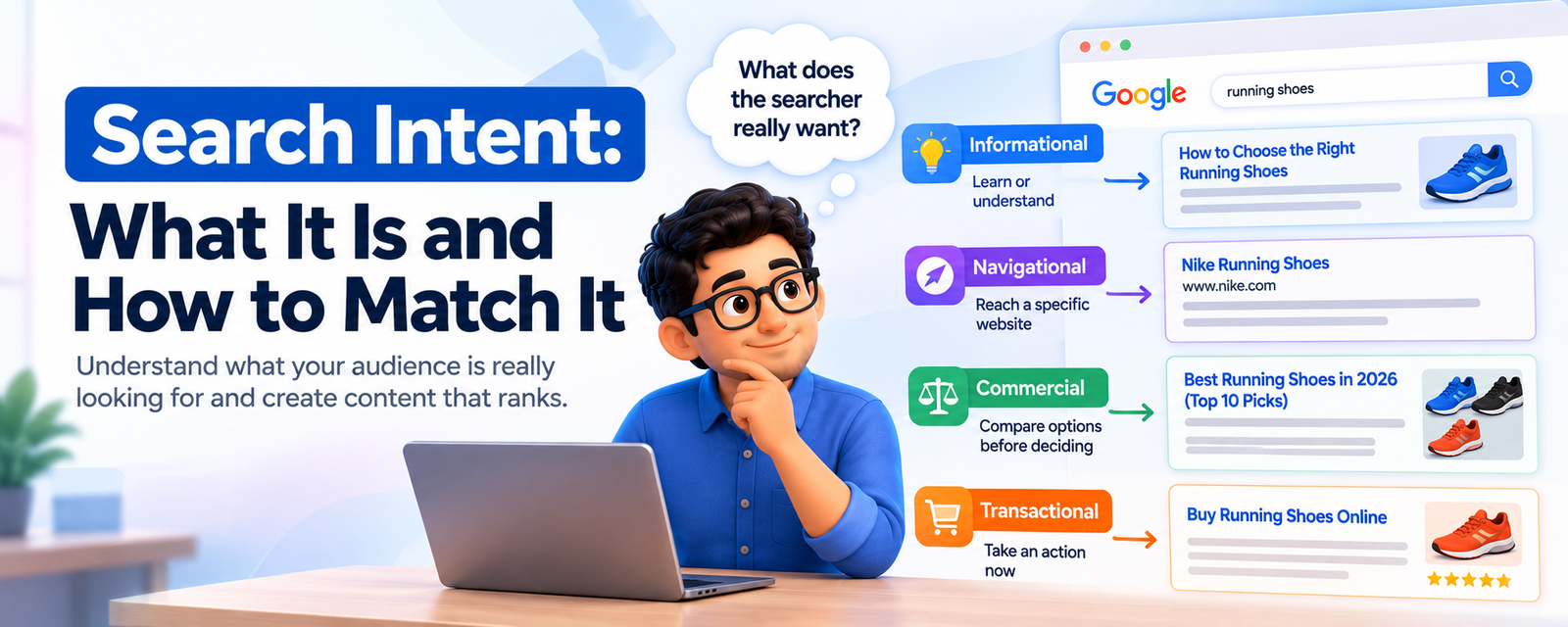
Search intent (or user intent) is the goal behind a search query. Two people can type almost the same words and want very different things, and one person's short query can hide a very specific need.
Google's whole job is to satisfy that goal. Its systems watch which kinds of results people find useful for a query and learn from that. Over time, the results for any keyword settle into a pattern that reflects what most searchers want. Your job is to recognise that pattern and build the best page for it.
If you want the bigger picture of how Google decides what to show, read our guide on how search engines work.
The four types of search intent
| Intent | The searcher wants to… | Typical words | Example query | Pages that usually rank |
|---|---|---|---|---|
| Informational | Learn or understand something | what, how, why, guide, tips | how to file GST return | Guides, how-tos, explainers, videos |
| Navigational | Reach a specific site or page | brand names, "login" | hdfc netbanking login | The brand's own page |
| Commercial | Compare options before deciding | best, top, vs, review, alternatives | best CRM for small business India | Listicles, comparisons, reviews |
| Transactional | Take an action now | buy, price, hire, book, near me | hire SEO consultant Noida | Product, service, pricing and booking pages |
1. Informational intent
The largest group of searches. People want an answer, an explanation, or instructions. "What is a canonical tag", "how to make masala chai", "why is my phone overheating".
These searchers aren't ready to buy, but they are forming opinions about who knows their stuff. A helpful answer today can become a customer next quarter. Informational content is also where you earn most citations in AI answers, because AI assistants are mostly asked informational questions.
2. Navigational intent
The person already knows where they want to go: "Zomato", "IRCTC login", "W3XHTML blog". You can't realistically rank for someone else's brand, and you shouldn't try. What you should do is make sure you rank first for your own brand name, with good sitelinks.
3. Commercial investigation
The searcher is evaluating. "Best laptops under 60000", "Shopify vs WooCommerce", "Zoho CRM review". They know roughly what they want and are narrowing down. These keywords are gold for businesses, because the searcher is close to a decision. Honest comparisons and detailed reviews tend to win here.
4. Transactional intent
The searcher is ready to act: buy, book, sign up, call. "Buy running shoes online", "dentist appointment Sector 62 Noida", "SEO audit price". Product pages, service pages, and booking pages rank for these, not blog posts.
Mixed and changing intent
Real searches don't always fit neatly. "SEO services" can be commercial (comparing agencies) and transactional (ready to hire). "iPhone 17" might be news right after launch, then comparison, then transactional. When results show a mix of page types, Google is telling you the intent is split. In that case, you either aim for the dominant type or build a page that serves both, for example, a service page with a clear comparison section.
Intent also shifts over time. Pandemic-era searches for "masks" changed completely in a few weeks. Check the results again every time you refresh an important page.
How to identify search intent (step by step)
You don't need a tool to do this well. You need ten minutes and an incognito window.
Step 1: Search the keyword yourself
Use an incognito or private window, set to the country you're targeting. Look at the top ten results, and ignore ads for now.
Step 2: Note the "three Cs"
This framework, popularised by Ahrefs, is still the most practical way I know:
Step 3: Look at the SERP features
The extra elements on the page are clues:
Step 4: Read the top three pages properly
Not skim, read. What questions do they answer? What do they skip? Where do they get vague? The gap between what they offer and what a searcher truly needs is your opportunity.
Step 5: Decide your page type before you write
Write it at the top of your content brief: "This will be a step-by-step how-to guide for beginners with screenshots." That one sentence prevents most intent mismatches.
A worked example: "best accounting software for small business"
Let's apply the process to a keyword a SaaS client might target.
What that means: if you sell accounting software, your product page won't rank for this keyword. What can rank is an honest, well-researched comparison that includes your product alongside competitors, covers GST features and pricing, and answers those PAA questions. Trying to force a sales page here wastes months.
How to match search intent on your page
Search intent and your content strategy
Intent isn't only a page-level concern. It shapes your whole content plan. A healthy site has pages for every stage:
| Stage | Intent | Example page for an SEO agency |
|---|---|---|
| Awareness | Informational | What is SEO? / How search engines work |
| Consideration | Commercial | SEO vs PPC / How to choose an SEO agency |
| Decision | Transactional | SEO services page / Free SEO audit |
Internal links should guide people from one stage to the next. A reader on an informational guide should find an easy path to the comparison page, then to the service page. That's also how topical authority is built.
When you're doing keyword research, tag every keyword with its intent. It makes prioritising much easier. And long-tail keywords usually have clearer intent than short ones, which is part of why they convert better.
Search intent in AI search
AI assistants like ChatGPT, Gemini and Perplexity handle intent in conversation. Someone might ask "what is technical SEO", then "how do I check my site", then "can you recommend an agency in Noida". Each turn moves from informational toward transactional.
To be part of that journey, you need content at every stage, written clearly enough to be quoted, plus a reputation strong enough to be recommended. Pages that directly answer one specific question under a clear heading are more likely to be pulled into AI answers.
Common search intent mistakes
Frequently asked questions
1. What is search intent in simple words?
It's the reason someone searches: what they want to learn, find, compare, or do.
2. What are the four types of search intent?
Informational, navigational, commercial investigation, and transactional.
3. Why is search intent important for SEO?
Because Google ranks pages that satisfy the searcher's goal. If your page doesn't match that goal, it won't rank well, however good it is.
4. How do I find the search intent of a keyword?
Search it and study the top results: what type of pages, what format and what angle they use, plus any SERP features like maps or AI Overviews.
5. Can a keyword have more than one intent?
Yes. When results show different page types, intent is mixed. Target the dominant intent or build a page that serves both clearly.
6. What is an example of informational intent?
"How to improve website speed" or "what is schema markup". The person wants knowledge, not a product.
7. What is an example of transactional intent?
"Buy wireless earbuds online" or "book dentist appointment near me". The person is ready to act.
8. What is commercial investigation intent?
It's when someone is comparing options before deciding, such as "best CRM software" or "Semrush vs Ahrefs".
9. Is navigational intent worth targeting?
Only for your own brand. Make sure you rank first for your company and product names.
10. Do SEO tools show search intent?
Tools like Ahrefs and Semrush label intent, and they're useful for large keyword lists. Always confirm important keywords by checking the live results yourself.
11. How does search intent affect content length?
It sets the depth needed. Quick definition queries need concise answers; complex how-to or comparison queries often need longer, detailed pages.
12. Can I rank a service page for an informational keyword?
Rarely. Create a helpful guide for the informational keyword and link from it to your service page.
13. What does a map pack in results mean for intent?
It signals local intent. To compete, you need a well-optimised Google Business Profile and local SEO, not only website content.
14. Does search intent change over time?
Yes. News events, seasons, and product launches can shift it. Recheck results for your key terms regularly.
15. How is search intent related to the buyer's journey?
Informational intent maps to awareness, commercial to consideration, and transactional to decision. You need content for each stage.
16. What is micro-intent?
It's the more specific need within a broad intent, such as "for beginners", "free," or "in India". Matching micro-intent helps you stand out.
17. How do long-tail keywords relate to intent?
Longer, more specific queries usually reveal intent more clearly, which makes them easier to satisfy and often better at converting.
18. How does search intent work in ChatGPT and AI search?
AI tools infer intent from the conversation. Clear, well-structured content for each stage of that conversation makes you more likely to be cited.
19. What happens if my page doesn't match search intent?
It usually ranks poorly or drops after a short test period, because users don't find what they wanted and choose other results.
20. How do I fix a page with the wrong intent?
Either rework it into the format that ranks for its keyword, or retarget it to a keyword whose intent it does match, and create a separate page for the original keyword.
Wrapping up
Keywords tell you what people type. Intent tells you what they mean. Get the second one right, and the rest of SEO becomes much easier.
Written by Ashwini
Technical author & editor at W3XHTML publishing guides on web development and SEO.