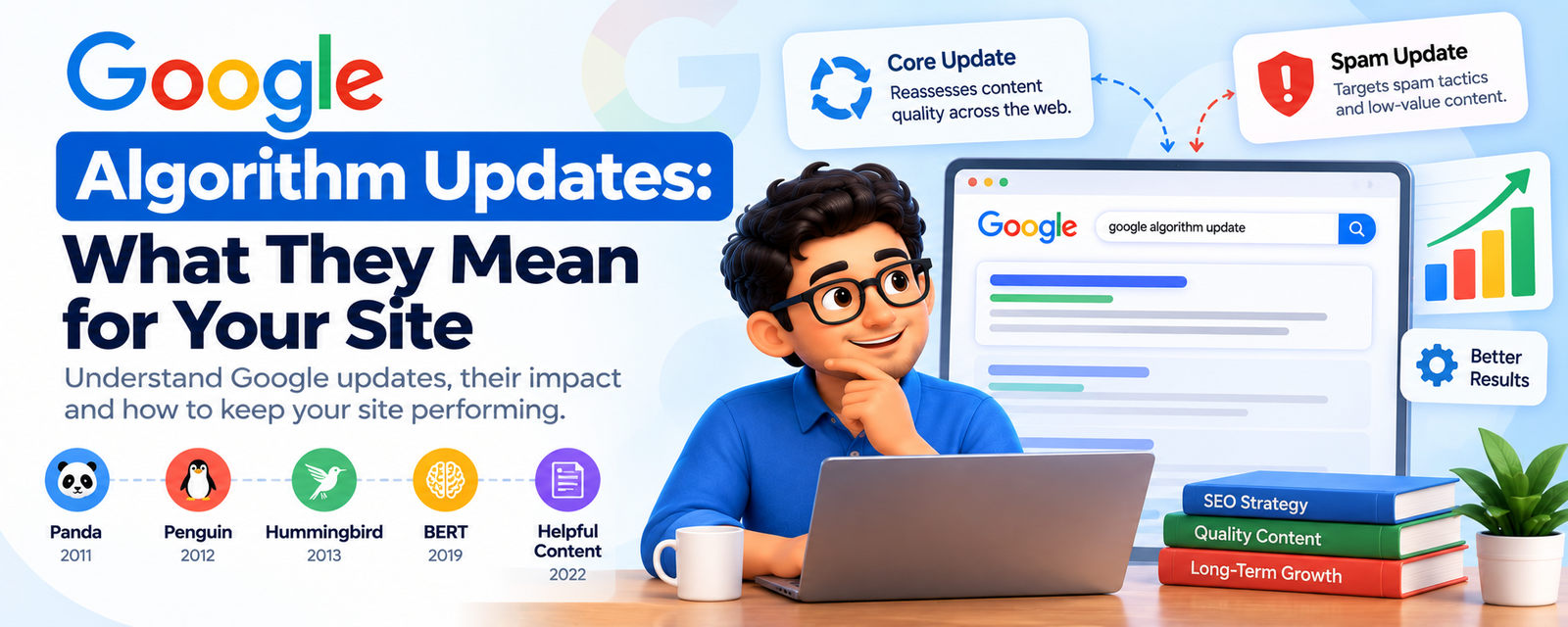
Key takeaways
- Google changes its ranking systems thousands of times a year. Only a few changes each year, mainly core updates and spam updates, are big enough to move rankings noticeably.
- Core updates reassess content quality across the web. A drop doesn't mean you were penalised; it means Google now prefers other pages for those searches.
- Spam updates target specific tactics such as link schemes, scaled low-value content, and site reputation abuse.
- The recovery playbook is the same almost every time: diagnose which pages and queries fell, compare them to what now ranks, and genuinely improve usefulness and trust.
Few things cause panic in marketing teams like a sudden traffic drop after a Google update. The Slack messages start, someone suggests rewriting every page, someone else wants to disavow half the backlink profile.
Take a breath. Algorithm updates are a normal part of search. Most sites that react calmly, with good diagnosis, recover or even grow. Most sites that panic make things worse. This guide explains what updates are, which ones shaped modern SEO, and exactly what to do when one hits you.
What is a Google algorithm update?
Google's search results are produced by many ranking systems working together. An algorithm update is any change to those systems. Google makes thousands of changes every year. Most are tiny and nobody notices.
A handful each year are significant enough that Google announces them. These fall into a few groups:
| Type | What it does | How often |
|---|---|---|
| Core updates | Broad changes to how Google assesses content relevance and quality overall | Several times a year |
| Spam updates | Improve detection of spam tactics, including link spam and scaled content abuse | A few times a year |
| Targeted system updates | Changes to specific systems, such as reviews or page experience | Occasional |
| Feature changes | New or changed search features, like AI Overviews | Ongoing |
Announced updates usually take one to two weeks to roll out fully. Google lists them on its Search Status Dashboard, which is the most reliable place to check whether something official is happening.
Updates that shaped modern SEO
You don't need to memorise update history, but knowing the big turning points explains why SEO works the way it does today.
| Year | Update | What changed |
|---|---|---|
| 2011 | Panda | Targeted thin, low-quality, and duplicate content. Ended the "content farm" era. |
| 2012 | Penguin | Targeted manipulative link building and keyword-stuffed anchor text. |
| 2013 | Hummingbird | Better understanding of whole queries and meaning, not just matching words. |
| 2015 | Mobile-friendly update | Mobile usability became a ranking consideration for mobile searches. |
| 2015 | RankBrain | Machine learning used to interpret unfamiliar queries. |
| 2019 | BERT | Deeper language understanding, especially of context words like "for" and "to". |
| 2021 | Page experience | Core Web Vitals joined other page experience signals. |
| 2022 | Helpful content system | Rewarded content written for people, not for rankings. |
| 2024 | March core update and new spam policies | Helpful content signals folded into core ranking; new policies against scaled content abuse, site reputation abuse, and expired domain abuse. |
| 2024 onward | AI Overviews and AI Mode | AI-generated summaries in search changed how many informational queries are answered. |
Notice the pattern. Almost every major update pushes in the same direction: less reward for manipulation, more reward for pages that genuinely help people. That's why chasing loopholes is a losing game.
Core updates vs spam updates: why the difference matters
Core updates
A core update doesn't target any specific site or tactic. It improves how Google evaluates content in general. Google's own comparison is useful: imagine a list of the best 100 films from 2015. Update the list today, and some films drop, not because they got worse, but because new films were made and tastes were reassessed.
So if you drop after a core update, there's usually nothing "broken" to fix. Other pages have been judged more helpful for those searches. The response is to improve, not repair.
Spam updates
Spam updates are different. They target specific violations of Google's spam policies: buying or exchanging links, hidden text, cloaking, auto-generated pages at scale, hosting low-quality third-party content to exploit a strong domain, and similar. If a spam update hits you, there often is something specific to remove.
Manual actions
A manual action is not an algorithm update. It's a penalty applied by a human reviewer at Google. You'll see it in Google Search Console under Security & Manual Actions, with a description of the issue. Fix the problem, then submit a reconsideration request.
How to tell if an update affected you
Not every traffic drop is an update. Before blaming Google, rule out the usual suspects:
- Tracking problems. Did GA4 tags break after a site change? Compare GA4 with Google Search Console clicks. If Search Console is stable and GA4 dropped, it's tracking.
- Technical issues. Accidental noindex tags, robots.txt blocks, a botched migration, server errors, or a slow new theme.
- Seasonality. Compare with the same period last year. Education queries drop after admissions season; festive shopping spikes and falls.
- SERP changes. A new AI Overview or more ads for your keywords can reduce clicks even if your ranking didn't move. Check impressions and average position alongside clicks.
- Competitor moves. A competitor published a much better page or earned major press.
If none of these explain it and the timing lines up with an announced update on the Search Status Dashboard, an update is the likely cause.
How to diagnose a drop after a core update
- Wait until the rollout is complete (Google announces when). Then compare the two weeks after the update with the two weeks before it in Search Console's Performance report.
- Find which pages lost clicks. Sort pages by change in clicks. Is it the whole site, one section (say, the blog), or a few pages?
- Find which queries lost positions. A drop from position 2 to 4 is very different from 5 to 25.
- Study what now ranks. For your most affected queries, open the pages that moved above you. What do they do better? Are they more detailed, more current, more experienced, better organised, from a more trusted source?
- Be honest about quality. Google publishes a list of self-assessment questions for core updates. A few of the most useful:
- Does the content provide original information, research or analysis?
- Does it provide a substantial, complete description of the topic?
- Would you trust this information, and would you bookmark or share it?
- Is it written by someone who clearly knows the topic?
- Does the page leave the reader feeling they've learned enough, or needing to search again?
A worked example
Consider a typical situation: a health information website in India sees a 35% drop in organic clicks after a core update. Here's how a sensible diagnosis might go.
- Search Console shows most losses are in 60 symptom and treatment articles; service pages are stable.
- Pages now ranking above them are from hospitals and medical publications, with named doctors as authors, cited research, and "medically reviewed by" notes.
- The site's articles are written by a general content team, have no author bios, and several are near-duplicates of each other.
Reasonable response: add qualified medical reviewers and real author profiles, merge overlapping articles, update facts with current sources, and add genuinely useful detail such as when to see a doctor and what tests involve.
Not: rewrite everything with more keywords, or disavow random links.
Health, finance and legal topics are held to higher standards.
How to recover from an algorithm update
After a core update
- Improve the pages that fell, starting with those that brought the most business value.
- Consolidate thin or overlapping content. Ten weak pages rarely beat one excellent one.
- Show real expertise: author bios, first-hand experience, original examples, data, and clear sourcing.
- Update outdated information. Old statistics and stale advice are common quality drags.
- Fix user experience issues that make pages frustrating: intrusive ads, slow loading, poor mobile layout.
Recovery takes time. Google's systems need to re-evaluate your site, and noticeable recovery often shows up around the next core update, sometimes later. Small improvements can show earlier.
After a spam update
- Stop any practices that break Google's spam policies: paid links, link exchanges, mass-produced pages, doorway pages.
- Remove or noindex low-quality content you can't improve.
- If you host third-party content (coupons, sponsored posts) unrelated to your main purpose, review it against the site reputation abuse policy.
- Don't rush to disavow links unless you have a manual action for unnatural links or clear evidence of a paid link scheme. Google already ignores most spammy links.
What not to do after an update
- Don't make big changes during a rollout. Rankings fluctuate during the 1 to 2 week rollout. Wait for it to finish.
- Don't delete content in bulk without analysis. You may remove pages that still bring valuable traffic.
- Don't change URLs or run a migration as a reaction. That adds new risk on top of the old problem.
- Don't trust "recovery hacks". There's no secret setting that reverses a core update.
- Don't judge by one day of data. Look at trends over several weeks.
How to future-proof your site against updates
You can't control Google, but you can make updates matter less to you:
- Build for people first. Write for your customer's real questions, with real expertise.
- Earn links; don't buy them.
- Keep the technical foundation clean with regular audits.
- Diversify traffic. Email lists, social, partnerships, and direct brand demand make any single update less scary.
- Monitor weekly. Set up Google Search Console alerts and review performance regularly so you catch changes early.
Frequently asked questions
1. What is a Google algorithm update?
It's a change to the systems Google uses to rank search results. Most are small; a few each year, like core and spam updates, have noticeable effects.
2. How often does Google update its algorithm?
Thousands of times a year. Google announces only the significant ones, typically several core updates and a few spam updates annually.
3. What is a Google core update?
A broad change to how Google evaluates content quality and relevance across all sites. It isn't aimed at any specific site or tactic.
4. Is a core update drop a penalty?
No. It means Google now considers other pages more helpful for those searches. There may be nothing technically wrong with your site.
5. Where can I see official Google updates?
On the Google Search Status Dashboard and the Google Search Central blog.
6. How long does a core update take to roll out?
Usually one to two weeks. Rankings can fluctuate throughout that period.
7. How long does recovery take after a core update?
It varies. Some improvement can appear within weeks, but meaningful recovery often shows around the next core update, after Google reassesses the site.
8. What is a spam update?
An update that improves Google's detection of practices that break its spam policies, like link schemes or mass-produced low-value pages.
9. What is the difference between a manual action and an algorithm update?
A manual action is a penalty applied by a Google reviewer and shown in Search Console. An algorithm update is automated and affects many sites at once.
10. How do I check for a manual action?
In Google Search Console, go to Security & Manual Actions → Manual actions. If there's an issue, it will be described there.
11. What was the helpful content update?
A system launched in 2022 to reward content written for people rather than for search rankings. In 2024, Google integrated it into its core ranking systems.
12. Does AI-generated content get hit by updates?
Google targets low-value content made mainly to manipulate rankings, however it's produced. Helpful, accurate, reviewed content isn't penalised simply for using AI tools.
13. Should I disavow links after a traffic drop?
Usually not. Google ignores most spammy links automatically. Disavow is mainly for manual actions or clear paid link schemes you can't remove.
14. Can an update affect only part of my site?
Yes. Often one section, such as the blog or product reviews, is affected while other sections stay stable.
15. How do I know if a drop is from an update or a technical issue?
Check timing against announced updates, then rule out tracking errors, noindex tags, robots.txt changes, server errors, and site migrations.
16. Do algorithm updates affect local SEO?
Yes. Core updates can affect local results too, and Google also adjusts local ranking systems from time to time.
17. Did AI Overviews change rankings?
AI Overviews changed how results look and can reduce clicks for some queries, even when rankings stay the same. Track impressions and positions, not only clicks.
18. Should I update old content after an update?
Yes, if it's outdated or thinner than what now ranks. Focus on genuine improvements, not just changing the date.
19. Can I predict the next Google update?
No one can predict exact timing or effects. Building genuinely helpful, trustworthy content is the only reliable protection.
20. Can an SEO agency guarantee recovery?
No honest agency can guarantee it. A good one can diagnose the cause, prioritise improvements and track progress transparently.
Final thoughts
Google's updates can feel like the ground moving under your feet. Step back, and the direction has been consistent for over a decade: help people, show real expertise, don't manipulate. Sites that follow that direction tend to gain from updates over time.
If an update has hit your traffic and you want a second opinion, our SEO services start with a clear diagnosis of what changed, why, and what to fix first.
Written by Ashwini
Technical author & editor at W3XHTML publishing guides on web development and SEO.